 Welcome To JG IT Solution
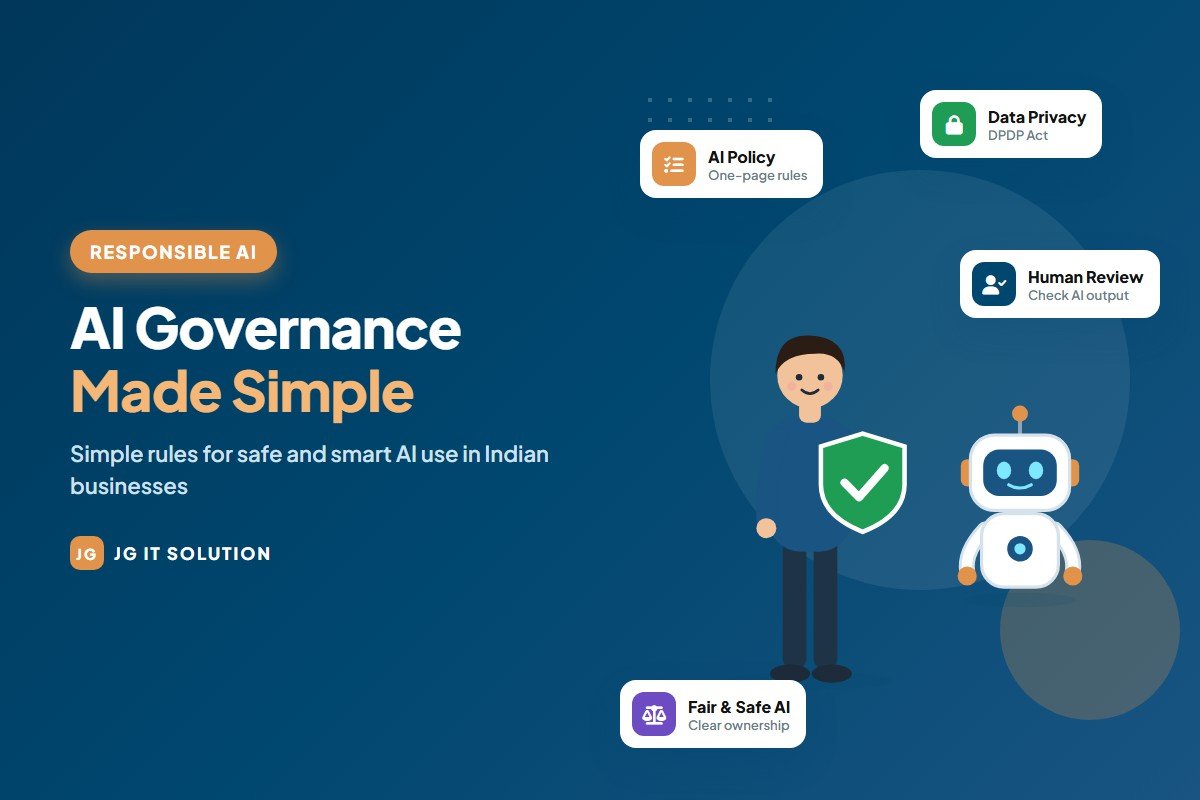
Your team is probably already using AI. Someone is writing emails with ChatGPT, someone is summarising reports with Claude or Gemini, and someone has connected an AI tool to customer data. This is great for productivity - but without simple rules, it can also create risks: leaked customer data, wrong information sent to clients, copyright problems or decisions nobody can explain.
This is where AI governance comes in. It sounds like a big, complicated word, but the idea is simple. In this guide, we explain what AI governance means, why it matters for Indian businesses of every size, and how to set up a practical AI governance framework in a few days - without any legal jargon.
What Is AI Governance?
AI governance is the set of rules, roles and checks that decide how your organisation uses AI - which tools are allowed, what data can be used, who reviews the output and what happens when something goes wrong.
Think of it like your company's travel or expense policy. Employees can still travel and spend money, but there are clear rules to keep things safe, fair and under control. AI governance does the same for AI tools.
A good governance approach answers five simple questions:
- Which AI tools are approved for use?
- What data can be shared with those tools?
- Who checks AI output before it is used?
- Who is responsible if something goes wrong?
- How do we stay updated with laws and new risks?
Why AI Governance Matters for Businesses
1. Protecting customer and company data
When employees paste customer lists, contracts or financial data into AI tools, that information may leave your control. Clear rules help prevent data leaks and protect your reputation.
2. Legal compliance
India's Digital Personal Data Protection (DPDP) Act, 2023 sets rules for how businesses collect and use personal data, including consent and security safeguards. Using AI with personal data must follow these rules too. The DPDP Rules are being implemented in phases. [VERIFY the latest DPDP Rules timeline on meity.gov.in]
3. Avoiding wrong or harmful output
AI can produce confident but incorrect answers, biased suggestions or content that copies others' work. Human review catches these mistakes before they reach customers.
4. Building customer trust
Customers increasingly want to know when AI is used and how their data is handled. Transparent AI use builds trust and long-term relationships.
5. Getting more value from AI
Governance is not only about stopping risks. When everyone uses approved tools in a consistent way, it becomes easier to train staff, share good prompts and measure results.
Key Principles of Responsible AI
Most AI governance frameworks around the world are built on a few common principles:
- Transparency: be clear about when and how AI is used.
- Accountability: a real person is responsible for every AI-supported decision.
- Privacy and security: protect personal and confidential data.
- Fairness: check that AI does not treat people unfairly, for example in hiring or lending.
- Human oversight: important decisions are reviewed by humans, not left fully to AI.
- Safety and reliability: test AI systems and monitor them over time.
Rules and Standards to Know
| Rule / Standard | What it is | Who should care |
|---|---|---|
| DPDP Act, 2023 (India) | India's data protection law for digital personal data | Every business handling customer or employee data in India |
| India AI governance guidelines | Government guidance on safe and trusted AI adoption [VERIFY latest MeitY publication] | Businesses building or deploying AI in India |
| EU AI Act | A risk-based AI law in the European Union | Indian companies serving customers in Europe |
| ISO/IEC 42001 | International standard for an AI management system | Companies wanting a formal, certifiable AI process |
| NIST AI Risk Management Framework | A voluntary US framework to manage AI risks | Teams wanting a structured risk checklist |
This article is for general information and is not legal advice. Please consult a legal professional for advice specific to your business.
How to Build a Simple AI Governance Framework (Step by Step)
You do not need a large compliance team. Even a 10-person business can set up basic AI governance in a week by following these steps.
Step 1: Make a list of AI tools in use
Ask every team which AI tools they use - chatbots, writing tools, meeting assistants, design tools, automation tools and AI features inside existing software. You will often find more than you expected.
Step 2: Classify your data
Divide your information into simple groups:
- Public: website content, brochures - safe to use with AI.
- Internal: internal plans and drafts - only with approved tools.
- Confidential: customer data, contracts, financials, passwords - never in public AI tools.
Step 3: Approve tools and set access
Choose a small list of approved tools. Prefer business or team plans that offer better data controls, admin settings and agreements about how your data is used. [VERIFY each vendor's business data terms]
Step 4: Write a one-page AI usage policy
Keep it short and clear so people actually read it. A sample policy is given below.
Step 5: Add human review
Decide which AI output must be checked by a person before use - for example customer emails, legal text, financial numbers, published content and anything related to hiring.
Step 6: Train your team
Run a short session on safe AI use, good prompts, common mistakes and what not to share. Repeat it when tools or rules change.
Step 7: Monitor and improve
Review the AI tool list and policy every few months. Keep a simple record of incidents - such as wrong information sent to a customer - and update the rules to prevent them.
Who Is Responsible? Simple Roles and Ownership
In a small business, one person may handle more than one role. What matters is that everyone knows who decides what.
| Role | Responsibility |
|---|---|
| Owner / Director | Approves the AI policy and takes final responsibility |
| AI coordinator (any senior team member) | Keeps the approved tool list, answers questions and updates rules |
| Team leads | Make sure their team follows the policy and reviews AI output |
| IT / technical person | Manages accounts, access, data settings and security |
| Every employee | Uses approved tools safely and reports problems quickly |
Real-Life AI Risks: 3 Simple Examples
Example 1: Customer data in a public chatbot
A sales executive pastes a full customer list with phone numbers into a free AI tool to "clean it up". The data has now left the company's control. Governance fix: classify customer data as confidential and allow it only in approved tools with proper data protection.
Example 2: Wrong information sent to a client
An employee asks AI for the GST rate on a product and sends the answer directly to a client - but the rate is outdated. Governance fix: require human review and verification from official sources for tax, legal and financial information.
Example 3: Biased hiring shortlist
HR uses an AI tool to shortlist CVs, and it unfairly rejects candidates from certain colleges or backgrounds. Governance fix: never let AI make hiring decisions alone; a trained person must review and decide.
Questions to Ask Before Buying an AI Tool
- Is our data used to train the vendor's AI models? Can we turn this off?
- Where is our data stored and for how long?
- Does the tool offer admin controls, user management and access logs?
- What security certifications or standards does the vendor follow?
- How can we export or delete our data if we stop using the tool?
- Does the tool support our legal requirements, such as the DPDP Act?
How Good Governance Helps Your Business Grow
Many business owners think governance is only about restrictions. In reality, clear rules give your team the confidence to use AI more, not less. When people know which tools are safe and how to use them, they experiment faster, share good results and avoid costly mistakes. Customers and partners also trust a business that handles AI and data responsibly - which can be a real advantage when bidding for larger clients or export orders.
Sample One-Page AI Usage Policy
You can copy and adapt this simple policy for your organisation:
- Use only AI tools approved by the company.
- Never enter passwords, OTPs, bank details, Aadhaar, PAN or confidential client data into AI tools that are not approved for such data.
- Always review and edit AI-generated content before sharing it outside the company.
- Verify facts, figures, legal and financial information from reliable sources.
- Do not use AI alone to make decisions about hiring, salaries, loans or customer eligibility.
- Tell customers when they are interacting with an AI chatbot.
- Respect copyright - do not present AI output as original if it copies others' work.
- Report any AI-related mistake or data issue to the responsible person immediately.
AI Governance Checklist for Small Businesses
- List of approved AI tools - updated
- Data classification - public, internal, confidential
- One-page AI usage policy - shared with all staff
- Human review rules for important output
- Person responsible for AI decisions and incidents
- Customer data handled as per the DPDP Act
- Team training completed
- Policy review date fixed (every 3-6 months)
Governance When You Build Your Own AI Features
If your business adds AI to its own website, app or software - for example a chatbot, recommendation system or automated decision tool - governance becomes even more important:
- Collect only needed data and take clear consent.
- Test the AI for wrong, biased or unsafe answers before launch.
- Keep logs so you can understand and explain what the system did.
- Give users a way to reach a human and correct mistakes.
- Secure the system with access control, encryption and regular updates.
Planning AI features in your product? Our website development and mobile app development teams build solutions with security and privacy in mind.
Common AI Governance Mistakes
- Banning AI completely: employees then use personal tools secretly, which is riskier.
- Writing a 30-page policy: nobody reads it. Keep rules short and practical.
- Ignoring AI inside existing software: many apps now have built-in AI features that also need rules.
- One-time effort: AI changes quickly, so governance must be reviewed regularly.
Conclusion
AI governance is not about slowing your business down - it is about using AI with confidence. Start small: list your tools, protect sensitive data, write a one-page policy, add human review and train your team. These simple steps protect your customers and your reputation while letting your team enjoy the full benefits of AI.
New to AI tools? Start with our list of the best AI tools for professionals, and learn how to save hours every week with AI workflow automation.
Frequently Asked Questions
-
What is AI governance in simple words?AI governance is a set of rules, roles and checks that decide how an organisation uses AI - which tools are allowed, what data can be shared, who reviews AI output and what happens when something goes wrong.
-
Why do small businesses need AI governance?Even small teams use AI tools with customer and company data. Simple governance rules help prevent data leaks, wrong information reaching customers and legal problems, while helping the team use AI with confidence.
-
Does the DPDP Act apply to AI tools?The Digital Personal Data Protection Act, 2023 applies to how businesses process digital personal data in India, including when that data is used with AI tools. Businesses should follow consent, purpose and security requirements. Consult a legal expert for specific advice.
-
What should an AI usage policy include?A simple AI usage policy should list approved tools, what data must never be shared, rules for human review of AI output, transparency with customers, copyright guidelines and how to report problems.
-
Should a company ban AI tools?Banning AI usually pushes employees to use personal tools secretly, which is riskier. It is better to approve safe tools, set clear rules and train the team.
-
How often should an AI policy be reviewed?Review your AI tools list and policy every three to six months, and whenever you adopt a new AI tool or laws change.