 Welcome To JG IT Solution
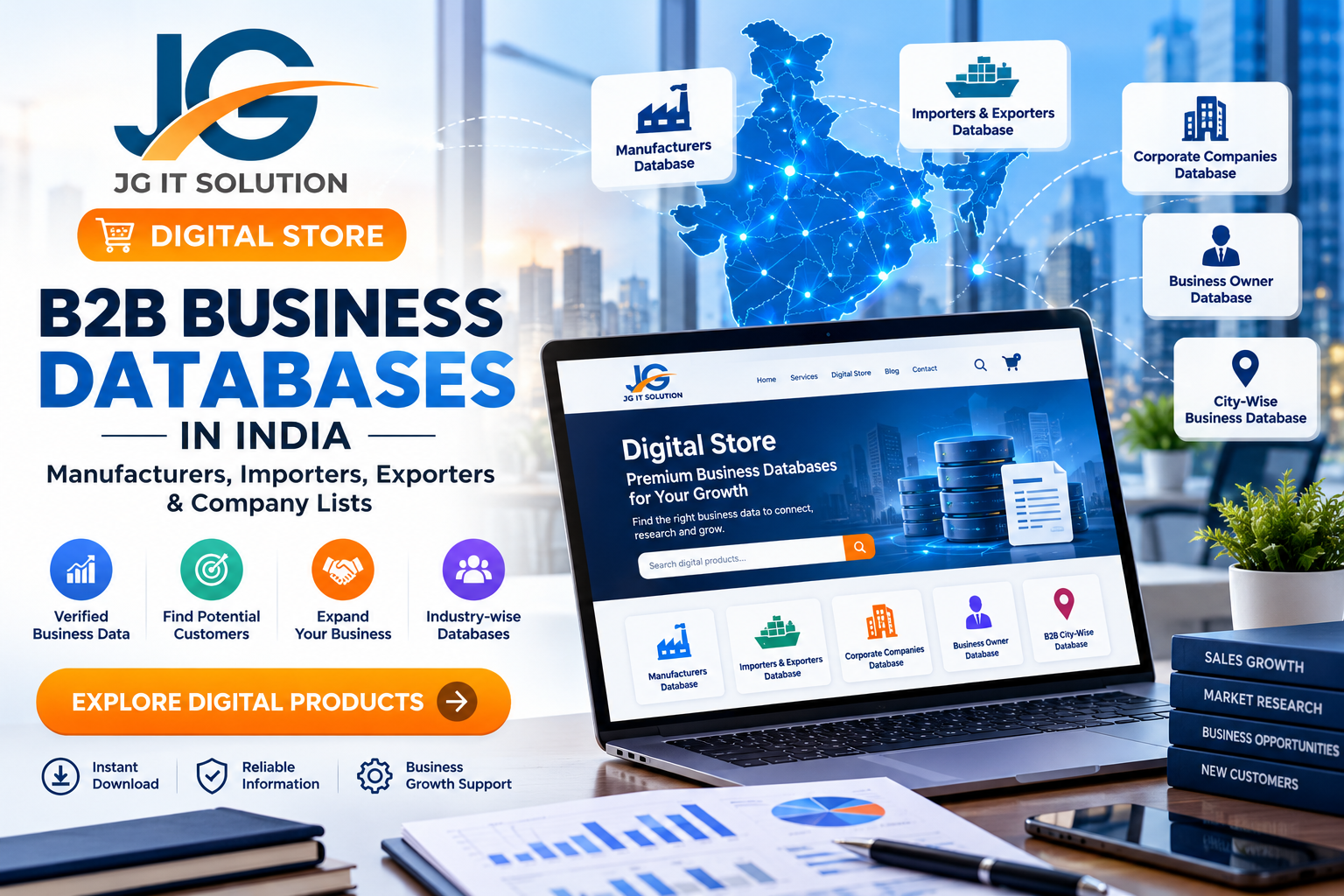
B2B Business Databases in India: Manufacturers, Importers, Exporters & Company Lists
Businesses that want to expand their market, identify potential customers or research new industries need reliable information about the companies they want to reach. Finding relevant businesses manually can take considerable time, especially when sales teams need to research multiple industries, cities or regions across India.
A structured B2B business database can help organize company information for business research, market analysis, supplier discovery and sales prospecting. Depending on its scope and data source, a business database may focus on manufacturers, importers, exporters, corporate companies, business owners or companies operating in specific cities.
JG IT Solution Digital Store offers digital database products designed for businesses exploring B2B company information and industry-specific business research.
Visit our Digital Products Store to explore available database products and their individual details.
In this guide, we explain what B2B business databases are, how different types of company databases can be used, what to check before purchasing a database and how businesses can select a suitable resource for their requirements.
Table of Contents
What Is a B2B Business Database?
Why Businesses Use Company Databases
Types of B2B Business Databases in India
Manufacturers Database
Importers and Exporters Database
Corporate Companies Database
Business Owner Database
B2B City-Wise Database
How to Choose the Right Business Database
Benefits of Structured Business Information
B2B Database Use Cases by Industry
How to Evaluate Data Quality
Business Database vs. Business Directory
Responsible and Compliant Use of Business Data
Frequently Asked Questions
Explore Digital Database Products at JG IT Solution
1. What Is a B2B Business Database?
A B2B business database is an organized collection of information about businesses that can support research, business planning, supplier discovery and sales prospecting.
B2B stands for business-to-business. It describes commercial activities in which one business provides products or services to another business.
For example, an industrial machinery supplier may want to research manufacturing companies that could require its equipment. A packaging supplier may want to identify food manufacturers, while a software company may research organizations that could benefit from its business applications.
A structured company database can help organize relevant business information into searchable or sortable records.
What Information Can a Business Database Include?
Depending on the database, its source and the specific product, records may include:
Company name
Business category or industry
City and state
Business address
Company website
Publicly listed business contact information
Available contact person or designation
Product or service category
Other relevant company information
Not every database includes every field. The actual coverage, format, verification status and update frequency should be checked on the individual product page before purchasing.
Who Can Benefit from B2B Business Databases?
Potential users include:
Manufacturers and industrial suppliers
Wholesalers and distributors
Importers and exporters
B2B service providers
Market research teams
Sales and business development teams
Consultants and agencies
Businesses exploring new geographic markets
A database is a research and prospecting resource. It does not guarantee that every listed company is interested in an offer or that every record will produce a qualified lead.
2. Why Do Businesses Use Company Databases?
Businesses frequently need to understand which organizations operate in their target market and which companies may be relevant to their products or services.
A structured database can help make that research more organized.
2.1 Identify Relevant Business Categories
A business selling industrial equipment may focus on manufacturers, while a packaging supplier may prioritize companies in food processing, pharmaceuticals or consumer goods.
Industry-based information can help narrow research to relevant business categories.
2.2 Explore New Markets
A company operating in one city may want to research opportunities in additional cities or states.
A suitable business database can help organize that research geographically, subject to the available coverage.
2.3 Support B2B Sales Research
Sales teams can use business information as a starting point for identifying organizations that may match their target customer profile.
Further research is still necessary to determine each organization's needs, suitability and purchasing requirements.
2.4 Research Suppliers and Business Partners
Business databases can also support supplier discovery, distribution research and the identification of potential business partners.
2.5 Organize Market Research
Structured company records can make it easier to sort information by business category, location or other available fields.
The value depends on the quality of the data and how closely it matches the research objective.
3. Types of B2B Business Databases in India
Different databases serve different research purposes. Selecting a suitable type starts with understanding which businesses you need to research.
Manufacturers Database
A manufacturers database focuses on manufacturing companies and industrial businesses.
It may be useful for industrial suppliers, machinery providers, raw material suppliers, packaging companies and other organizations serving the manufacturing sector.
Explore: Manufacturers Database.
Importers and Exporters Database
An importers and exporters database focuses on businesses involved in international trade.
Depending on its scope, it may support research into import-export companies, trading businesses and organizations operating in relevant product categories or markets.
Explore: Importers and Exporters Database.
Corporate Companies Database
A corporate companies database organizes information about companies for business research and market mapping.
Its suitability depends on the companies covered, the available fields and the intended use.
Explore: Corporate Companies Database.
Business Owner Database
A business owner database focuses on available business-related information associated with owners or business operators.
Before purchasing, check what information is included, where it comes from and whether the intended use is permitted.
Explore: Business Owner Database.
B2B City-Wise Database
A city-wise database organizes businesses according to geographic coverage.
It may help businesses research a selected city or regional market rather than working with a broad national dataset.
Explore: B2B City Wise Database.
To compare available options, visit the JG IT Solution Digital Store.
4. Manufacturers Database: Researching Manufacturing Companies in India
A manufacturers database is designed around businesses involved in producing goods, components, materials or industrial products.
Manufacturing companies operate across numerous sectors, including engineering, textiles, chemicals, food processing, plastics, packaging, electronics and machinery.
Businesses that supply products or services to manufacturers may use structured company information to identify organizations worth researching.
Common Use Cases
Industrial machinery suppliers: Research manufacturing businesses that may use relevant production equipment.
Raw material suppliers: Identify companies operating in industries that use the materials they supply.
Packaging companies: Research manufacturers whose products may require packaging materials or services.
Software providers: Identify manufacturing organizations that may benefit from inventory, accounting, ERP or other business systems.
Logistics providers: Research companies whose operations may require transportation, warehousing or related services.
What Should You Check Before Purchasing?
Before selecting a manufacturers database, consider:
Industries and company types covered
Geographic coverage
Available business information fields
File format and usability
Data source and verification process
Update frequency, if specified
Product-specific terms and limitations
Do not assume that every manufacturing company in India is included or that every contact detail is current.
View the product: Manufacturers Database by JG IT Solution.
5. Importers and Exporters Database: Researching International Trade Businesses
Importers and exporters operate across domestic and international supply chains. Depending on their activities, they may source products, distribute goods, work with manufacturers or serve overseas markets.
An importers and exporters database can help organize research into companies operating in relevant trade categories.
Who May Find This Type of Database Useful?
Manufacturers exploring export markets
Importers researching potential suppliers
Export service providers
Logistics and freight businesses
Packaging and labelling suppliers
Trade consultants
Businesses researching international commercial opportunities
Questions to Ask Before Buying
Before selecting a database, determine:
Which types of import-export businesses are included?
What countries, states or cities are covered?
Which business fields are available?
What file format is supplied?
Is the source and coverage explained?
Are there product-specific restrictions or usage conditions?
International trade activity can change over time. Verify important company information before making business decisions.
View the product: Importers and Exporters Database.
6. Corporate Companies Database for Business Research
A corporate companies database may help organizations research companies operating within a selected business market.
Its value depends on the company types covered and the information available in the specific dataset.
Potential Applications
Corporate market research
Business category analysis
Supplier and partner discovery
Geographic market mapping
Company research for sales planning
Industry research for business development
For example, a company providing enterprise software may research organizations whose business operations are compatible with its offering. A consulting firm may use corporate company information to build a list of organizations for further research.
How to Evaluate a Corporate Database
Review the scope, company coverage, data fields, source information, update status and applicable usage conditions.
Do not treat a company's presence in a database as evidence that it is actively seeking a particular product or service.
View the product: Corporate Companies Database.
7. Business Owner Database: Understanding the Product Scope
A business owner database may organize business-related information associated with owners or operators, depending on the product's source and scope.
Such a database should be evaluated carefully because the type of information included and the permitted uses can vary.
What to Review
Whether the product contains business-level or individual-level information
Which fields are actually included
How the information was obtained
Whether the source and update status are documented
Whether the intended use is lawful and consistent with the product terms
Whether additional verification is needed
Purchasing a database does not automatically provide permission to contact every listed person through every communication channel.
View the product: Business Owner Database.
8. B2B City-Wise Database for Local Market Research
A city-wise business database can help organizations research companies in a defined geographic area.
For example, a supplier may focus on a particular industrial region, while a service provider may research businesses within its intended service area.
Why Geographic Segmentation Matters
A geographically focused research plan can help businesses:
Understand the market in a selected city
Identify potentially relevant company categories
Organize sales research by region
Compare business opportunities across locations
Prioritize markets based on operational capacity
The availability of specific cities and business categories depends on the product's actual coverage.
Before purchasing, verify whether the selected database includes the location and type of business you need.
View the product: B2B City Wise Database.
9. How to Choose the Right B2B Business Database
The right database is the one that fits your actual research objective, not necessarily the one with the broadest title.
Step 1: Define Your Business Objective
Determine whether you want to research manufacturers, trade businesses, corporate companies or businesses in a particular city.
Step 2: Identify Your Target Industry
Choose the industry or company type relevant to your product or service.
Step 3: Define Geographic Coverage
Decide whether you need a city-specific, state-specific or broader national dataset.
Step 4: Check Available Fields
Confirm that the database contains the information needed for your intended research.
Step 5: Review Source and Quality Information
Look for transparent information about coverage, collection methods, update status and verification.
Step 6: Check Format and Compatibility
Confirm that the supplied format is compatible with your intended workflow.
Step 7: Review Terms and Compliance
Understand the applicable product terms, permitted uses and relevant privacy or communication requirements.
Step 8: Compare the Available Products
Review the individual product pages rather than choosing based only on a category name.
Start comparing available options in the JG IT Solution Digital Store.
10. Benefits of Structured Business Information
When appropriately sourced and relevant to a business objective, structured company information can support several activities.
More Organized Research
A structured dataset can reduce the effort required to organize company information manually.
Better Market Segmentation
Businesses can categorize research according to industry, location or other available fields.
More Focused Prospect Research
Teams can investigate organizations that appear relevant to their products or services before deciding whether to approach them.
Supplier and Partner Discovery
Business information may support research into potential suppliers, distributors or commercial partners.
Market Expansion Planning
Businesses can use company research alongside industry analysis and other evidence when evaluating new markets.
Better Research Workflows
Consistent records can be easier to sort, review and maintain than information collected from unrelated sources.
These benefits depend on the quality of the information and the process used to evaluate it. A database by itself does not guarantee leads, customers, revenue or business growth.
11. B2B Database Use Cases by Industry
Manufacturing and Engineering
Industrial suppliers can research companies operating in relevant manufacturing categories and regions.
Wholesale and Distribution
Wholesalers may research potential suppliers, distributors or commercial partners that fit their product categories.
Import and Export
Trade businesses can use company research to identify organizations that may be relevant to sourcing or distribution opportunities.
Software and Technology
Software providers may research companies that could benefit from suitable business systems, subject to the relevance of the offer.
Logistics and Supply Chain
Logistics providers can investigate organizations whose operations may require transport, storage or related services.
Marketing and Consulting
Agencies and consultants may use company research to understand their target market and identify organizations for further evaluation.
Each use case requires additional research to establish relevance. A company should not be approached simply because its name appears in a dataset.
12. How to Evaluate Business Database Quality
A database's usefulness depends on its relevance, accuracy, completeness and suitability for the intended purpose.
Relevance
Does the dataset cover the companies or industries you actually need?
Accuracy
Are important company details correct? Can key records be independently verified?
Completeness
Does the dataset contain the fields necessary for your research?
Freshness
Is there information about when the records were collected, reviewed or updated?
Consistency
Are company names, locations and categories presented in a usable and consistent format?
Transparency
Does the product description explain its scope and limitations clearly?
Usability
Can you sort, filter, review and maintain the information efficiently?
Before purchasing any database, read the product description and terms carefully. If a particular field, verification method or update period is not stated, do not assume it is included.
13. Business Database vs. Business Directory
Although these terms are sometimes used interchangeably, they can describe different types of resources.
Business directory: Generally helps users find businesses through categories, locations or listings.
Business database: May provide a structured dataset with fields that can be organized or analyzed for a particular research purpose.
The actual distinction depends on the product. A directory may provide downloadable data, while a database may have limited fields or coverage.
When comparing products, focus on the actual information supplied, how it can be accessed and whether it meets your requirements.
14. Responsible and Compliant Use of Business Data
Business information should be used responsibly. The fact that information appears in a database does not automatically mean that every form of marketing outreach is permitted.
Before using business data:
Verify the relevance and accuracy of important records.
Respect applicable privacy and data-protection requirements.
Follow applicable rules for email, SMS, telephone and other communications.
Respect opt-out requests and communication preferences.
Use appropriate consent and authorization where required.
Avoid misleading messages, unsolicited bulk outreach and prohibited practices.
Follow the product's terms and applicable laws.
Businesses should obtain legal guidance where the intended use or applicable requirements are unclear.
A responsible research process focuses on relevant organizations, appropriate communication and respect for individual preferences.
15. Frequently Asked Questions About B2B Business Databases
What is a B2B business database?
A B2B business database is an organized collection of business information used for purposes such as market research, company discovery, supplier research and sales prospecting.
Which B2B database products are available at JG IT Solution?
The Digital Store currently lists products such as Manufacturers Database, Importers and Exporters Database, Corporate Companies Database, Business Owner Database and B2B City Wise Database.
Visit the Digital Store to review the current products and their details.
What is a manufacturers database used for?
A manufacturers database can support research into manufacturing companies, industrial suppliers and other businesses within the manufacturing sector. Its usefulness depends on the included records and fields.
What is an importers and exporters database?
It is a business information resource focused on import-export companies or other trade-related businesses, depending on the specific product.
What is a corporate companies database?
It is a structured resource for researching corporate businesses. The exact coverage and fields depend on the dataset.
What is a city-wise business database?
It is a database organized around businesses in selected cities or geographic areas. Availability depends on the specific product.
How do I select a suitable database?
Identify your target company type, industry, geographic coverage, required fields and intended use. Then compare these requirements against the actual product description.
Are all business databases verified and regularly updated?
No general assumption should be made. Verification methods, source quality and update frequency vary by provider and product. Check the relevant product information before purchasing.
Can a business database guarantee B2B leads or sales?
No. A database may support research and prospecting, but lead qualification and sales depend on many additional factors, including relevance, the offer, customer requirements and the sales process.
Can purchased business information be used for marketing?
Only where the intended use complies with applicable laws, privacy requirements, communication rules and product terms. Purchasing data does not automatically establish permission for every type of marketing outreach.
Where can I explore digital database products?
Visit the JG IT Solution Digital Store to review the available product listings, prices and descriptions.
16. Explore B2B Digital Database Products at JG IT Solution
Finding relevant business information is an important part of market research, supplier discovery and business development. A well-selected database can help organize research around a particular industry, company type or geographic market.
The right choice depends on the information available, the source, the product's coverage and the intended business use.
JG IT Solution provides a selection of digital database products that you can review according to your requirements.
Explore Available Products
Visit the complete store: JG IT Solution Digital Products
Review each product's description, available information, price and usage conditions before making a purchase.
For assistance with a product or its requirements, contact JG IT Solution through the official website.
JG IT Solution
Rajkot, Gujarat, India
Website: jgitsolution.in
Email: info@jgitsolution.in
Phone: +91 81412 32527
JG IT Solution — Digital products and business information resources for your research needs.